CSYE Glosses
Connecting the Dots
Understanding Rare Variants Using Multiple Corpora
One of the unanticipated benefits of working as a transcriber for the CSYE has been the way that this work has complemented my research on another corpus of fascinating first-person Yiddish narratives: the Yiddish-language autobiographies submitted by youth to contests held by YIVO in 1932, 1934, and 1939.
Under the leadership of Max Weinreich, YIVO scholars with an interest in youth research encouraged young Jews aged 16 to 22 to send in detailed accounts of their lives. A total of 627 autobiographies were submitted, more than 300 of which are preserved in YIVO’s collections. The autobiographies have now been digitized and made freely available online. Most of the autobiographers hailed from Poland and wrote in Yiddish, but youth from elsewhere in Eastern Europe and around the world participated in the latter two contests, and the collection also includes entries in Polish, Hebrew, and a handful of other languages.1 The autobiographies have offered a wealth of material to scholars researching social, literary, political, gender-related, and educational aspects (among many others) of Jewish life in interwar Poland. My own research examines the narratives of disabled Polish Jews who participated in the contests.
Like the testimonies transcribed in the CSYE, the YIVO youth autobiographies can also serve as a valuable source for linguistic analysis. The writers come from many different cities, towns, and villages; their texts are long (a minimum of 25 pages was stipulated by the contest guidelines) and generally written in very legible handwriting; and the narratives cover a huge array of different subjects, so there are plenty of opportunities to encounter specialized vocabulary. The autobiographies were typically not edited by anyone other than the writers themselves and, while many of them made efforts to avoid regionalisms and adhere to standards of published written Yiddish, the vocabulary, grammar, and spelling still reflect some of the particularities of a given writer’s dialect.
Assuming that contestants adhered to the age guidelines,2 they would have been born between 1909 and 1923, so they were a roughly similar age cohort to the speakers featured in the CSYE. Working with these two corpora simultaneously has given me opportunities to make connections between the YIVO autobiographers and CSYE interviewees — in both their narratives and their language use. In a few instances, I encountered variants in a CSYE interview that were totally unfamiliar to me, and then later I happened to find those same variants in an autobiography. Without the attestation of a given word in both oral and written sources, I would have struggled to make sense of what I was reading and hearing.
‘And then…’
For example, when I was transcribing the testimony of Liuba Feldman (b. 1921) from Kovne, I was somewhat puzzled by a term she employed when introducing one event that followed another. Eight times in her interview, she used what I guessed was the Russian conjunction а ‘and, but’ followed by the Yiddish adverb נאַכער nakher ‘then, afterwards.’ In the following clip, she says what I initially transcribed as two words (the first being a borrowing): A nakher hob ikh genumen di kleyder, di zakhn vos kh’hob gehat ‘And then I took the clothes, the items that I had.’
A נאַכער האָב איך גענומען די קלײדער, די זאַכן װאָס כ'האָב געהאַט. A nakher hob ikh genumen di kleyder, di zakhn vos kh'hob gehat.
Liuba Feldman (Tape 4, 06:11–06:15)
From the collection of the USC Shoah Foundation
A little while later, I was reading the 1934 YIVO autobiography of a young man writing under the pseudonym “Yerukhemzon” (b. 1913), from Yashinevke, near Byalistok.3 I was surprised to find the adverb אנאכער anakher, spelled as a single word, in the same contexts I would expect to find נאַכער nakher. A search of the Yiddish Book Center’s collection using Optical Character Recognition (OCR) does not yield a single hit for the word אַנאַכער anakher in published Yiddish books, but it was evidently a part of this man’s everyday lexicon; I counted seven instances in his autobiography. In the fragment pictured below, “Yerukhemzon” writes אנאכער האט ער מיר געפרעגט anakher hot er mir gefregt ‘then he asked me.’

I immediately thought of Liuba Feldman. My initial assumption was called into question: rather than a mixed Russian-Yiddish two-word phrase, אַנאַכער anakher appears to be a single vocabulary item of its own. I’m not able to say for certain that this is the same variant I’m hearing in Liuba Feldman’s testimony, but it now seems much more plausible to me than my initial guess. It is worth noting, though, that Feldman uses נאַכער nakher much more frequently in her testimony than אַנאַכער anakher, whereas “Yerukhemzon” never writes נאַכער nakher. I’m hoping that I might come across further documentation of this variant that could offer more clarity on its status and geographic spread.4
‘Cousins’
The YIVO youth autobiography collection also helped to confirm another variant that was totally new to me: a term used by some speakers of Northeastern Yiddish to refer to a (male) cousin. Standard Yiddish has multiple options for referring to the child of one’s parent’s sibling: דער קוזין der kuzin (with the stress on either the first or the second syllable), די קוזינ(ק)ע di kuzin(k)e, and דאָס שװעסטערקינד dos shvesterkind. When I listened to the testimony of Shmuel Bushkin (b. 1925) of Rige, though, he seemed to be saying something else entirely. Twice in his testimony, he said something that sounded like קוזאַנג kuzang (with stress on the second syllable), or perhaps קוזאַנק kuzank.
און זײַן קוזאַנג un zayn kuzang
Shmuel Bushkin (Tape 8, 21:08–21:11)
From the collection of the USC Shoah Foundation
I wasn’t sure what to make of this. Later, I heard Nina Zlatkin (b. 1920) of Vilne using the word in the plural: קוזאַנגען kuzangen, and I felt more confident that this really was what I was hearing.
איך פֿלעג קומען צו מײַנע קוזאַנגען. ikh fleg kumen tsu mayne kuzangen.
Nina Zlatkin (Tape 1, 08:15–08:19)
From the collection of the USC Shoah Foundation
Again, an OCR search revealed no instances of this variant in the Yiddish Book Center’s collection. However, as I was reading the 1934 autobiography of Khane Hoykhman (b. 1911),5 a Riger like Shmuel Bushkin, I was pleased to find that she also uses this variant to refer to a male cousin (she uses קוזינע kuzine for a female cousin). She spells the word two different ways. In the fragment below, she spells it קוזײנק kuza(y?)nk:
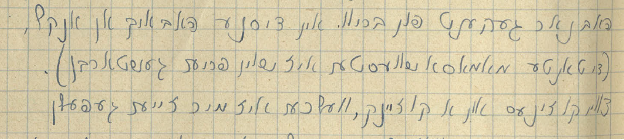
אין דיסנע האב איך אן אנקל, […] צװײ קוזינעס און א קוזײנק
in disne hob ikh an onkl, […] tsvey kuzines un a kuza(y?)nk
'In Disne I have an uncle, […] two female cousins and a male cousin'
In the subsequent pages, she uses the spelling קוזאנק kuzank three times, including in the following:

װי איך האב דערזען דעם קוזאנק, אזױ האב איך זיך גלײך אנטױשט אין אים.
vi ikh hob derzen dem kuzank, azoy hob ikh zikh glaykh antoysht in im.
'As soon as I laid eyes on my (male) cousin, I was disappointed by him.'
I am assuming that both spellings, קוזײנק kuza(y?)nk and קוזאנק kuzank, refer to the same pronunciation.6 Since Hoykhman is unlikely to have come across this variant in published texts, it makes sense to me that she would be uncertain as to how to spell it. To me, the word used by Shmuel Bushkin sounds more like קוזאַנג kuzang, and Nina Zlatkin’s plural definitely sounds like it contains a [g] rather than a [k]. In any event, Hoykhman’s autobiography provides a valuable written confirmation that a word like this was indeed in use in this region in the mid-1930s as a term for a male cousin. (Perhaps relatedly, the German noun Cousin is also pronounced variably with either a final [n] or a final [ŋ].)
‘Trees’
For variants that are attested but infrequent in the published Yiddish literature, the CSYE and YIVO autobiographies can work in concert to provide a more detailed snapshot of their usage. Yiddish dictionaries list the plural of בױם boym ‘tree’ as בײמער beymer, but an OCR search of the Yiddish Book Center’s collection yields numerous instances of the alternative plural בױמען boymen in published Yiddish books, including ones by the well-known writers Sholem Asch and Yehoash.7 While beymer is by far the dominant variant among speakers in the CSYE, there is (as of the time of writing) one documented instance of this alternative plural. Rita Yelgin, who was born in Slonim in 1923 but grew up in Grodne, pronounces the word with a clear [n] at the end. Because she is a speaker of Northeastern Yiddish, and therefore pronounces the diphthong <ױ> as [ej] in some words, a case could be made for spelling this variant either בױמען boymen or בײמען beymen.
זײער געדיכט, בײמען און, און, און SHRUBS zeyer gedikht, beymen un, un, un SHRUBS
Rita Yelgin (Tape 6, 02:49–02:53)
From the collection of the USC Shoah Foundation
“Shifre,” a young woman from Byalistok born sometime during World War I — also a speaker of Northeastern Yiddish — spells the word בױמען boymen in her 1934 YIVO autobiography in the phrase pictured below:8

די בױמען שטײען װי פארטרױמט
di boymen shteyen vi fartroymt
'the trees stand as though lost in thought'
It seems, from a very small and preliminary sample, that the variant plural בױמען boymen may have been more common among Northeastern Yiddish speakers, but further investigation would be required to confirm that.
Folk Dialectology
As I make use of the YIVO autobiographies alongside the CSYE testimonies to gain a better understanding of the rich regional variation of the Yiddish language, I’ve also been pleased to find that some writers recorded sociolinguistic observations of their own. Their comments reveal not only which differences between regional dialects stood out to them, but also their emotional and social responses to unfamiliar Yiddish speech. Khane Hoykhman, the woman from Rige mentioned above, provides the following commentary on a 5-week trip she took at age 12 to the small town of Pridruysk in southeastern Latvia, on the border with Poland. This was her first time traveling outside of Rige, and she explains her amusement with the way her relatives in Pridruysk spoke as well as her own experimentation with this new dialect:
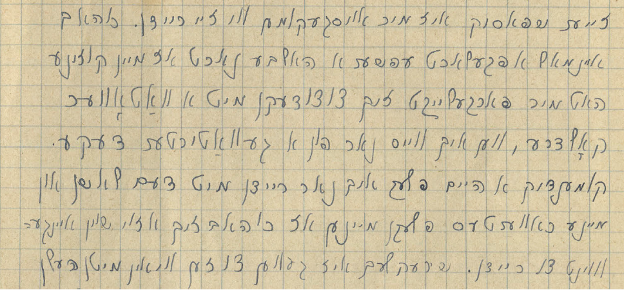
זײער שפאסיק איז מיר אױסגעקומען װי זײ רײדן. כ'האב אײנמאל אפגעלאכט עפשער א האלבע נאכט אז מײן קוזינע האט מיר פארגעלײגט זיך צוצודעקן מיט א װאַטאָװער קאָלדרע, װען איך װײס נאר פון א געװאַטירטער דעקע. קומענדיק אהײם פלעג איך נאר רײדן מיט דעם לאשן און מײנע כאװערטעס פלעגן מײנען אז כ'האב זיך אזױ שױן אײנגעװױנט צו רײדן.
zeyer shpasik iz mir oysgekumen vi zey reydn. kh'hob eynmol opgelakht efsher a halbe nakht az mayn kuzine hot mir forgeleygt zikh tsutsudekn mit a vatover koldre, ven ikh veys nor fun a gevatirter deke. kumendik aheym fleg ikh nor reydn mit dem loshn un mayne khavertes flegn meynen az kh'hob zikh azoy shoyn ayngevoynt tsu reydn.
'I found the way they spoke really funny. One time I spent perhaps half a night laughing when my (female) cousin suggested covering up with a vatove koldre ['quilted blanket'], when I'd only heard of a gevatirte deke ['quilted blanket']. When I returned home, I spoke exclusively in that language and my girlfriends thought that I'd already become accustomed to speaking like that.'
Hoykhman’s captivation by the subtle differences in the Yiddish spoken on opposite sides of Latvia is something I can relate to. Both the CSYE and the YIVO youth autobiography collection have given me the chance to explore and delight in the diversity of the Yiddish language, and I look forward to continuing to discover new (to me) variants in both spoken and written Yiddish.
Notes and References
-
For an excellent overview of the YIVO autobiography contests, I recommend the introduction to Awakening Lives: Autobiographies of Jewish Youth in Poland before the Holocaust (a collection of translations edited by Jeffrey Shandler, 2002), written by Barbara Kirshenblatt-Gimblett, Marcus Moseley, and Michael Stanislawski. ↩
-
Not all contestants followed the rules. Beba Epstein, for instance, wrote her autobiography when she was just 11 or 12 years old. YIVO has created an interactive online exhibition based on her life: https://museum.yivo.org/experiences/introduction/ ↩
-
“Yeruchamzon,” Jasionówka, Yugfor #42, 1934, Box 14, Folder 3683. Autobiographies of Jewish Youth in Poland, RG 4. YIVO Institute for Jewish Research. https://archives.cjh.org/repositories/7/archival_objects/1171301. ↩
-
The Groyser verterbukh fun der yidisher shprakh (vol. 1, p. 2) includes an entry for אַ־ a- as a prefix appended to pronouns and adverbs in order to add emphasis. The entry notes that this a- occurs far more frequently in spoken than in written Yiddish. It seems very plausible that anakher is an instance of this phenomenon. Thank you to Eliezer Niborski for making this connection and bringing it to my attention! ↩
-
Khane Hoykhman, Riga (Latvia), Yugfor #205, 1931–1934, Box 1, Folder 771. Records of the YIVO Institute for Jewish Research in the Martynas Mažvydas National Library of Lithuania, RG 8004. YIVO Institute for Jewish Research. https://archives.cjh.org/repositories/7/archival_objects/1287238. ↩
-
[Editor’s note (Isaac L. Bleaman): In handwritten Yiddish, especially from writers who speak the Northeastern (“Lithuanian”) dialect, one frequently encounters the forms <ײ> and <ײַ> for standard Yiddish <ע> and <אַ>, respectively, before a velar nasal sequence such as <נק> and <נג>. For example, <אָנדײנק> for <אָנדענק> ondenk ‘memory’ or <לײַנג> for <לאַנג> lang ‘long.’ Such nonstandard spellings reflect the more diphthongal pronunciation of these vowels in Northeastern Yiddish.] ↩
-
An example of boymen from Sholem Asch can be found here (p. 242), and two examples from Yehoash can be found here (p. 86). ↩
-
“Shifra,” Białystok, Yugfor #168, 1934, Box 3, Folder 3537. Autobiographies of Jewish Youth in Poland, RG 4. YIVO Institute for Jewish Research. https://archives.cjh.org/repositories/7/archival_objects/1171166. ↩
Cite this article
- Jany, Eli. 2026. "Connecting the Dots: Understanding Rare Variants Using Multiple Corpora." In Isaac L. Bleaman (ed.), Corpus of Spoken Yiddish in Europe (CSYE) Glosses, https://www.yiddishcorpus.org/csye/glosses/connecting-the-dots. Accessed .
-
@InCollection{Jany-2026,
    author    = {Eli Jany},
    booktitle = {Corpus of {Spoken} {Yiddish} in {Europe} ({CSYE}) {Glosses}},
    editor    = {Isaac L. Bleaman},
    title     = {Connecting the Dots: Understanding Rare Variants Using Multiple Corpora},
    url       = {https://www.yiddishcorpus.org/csye/glosses/connecting-the-dots},
    urldate   = {},
    year      = {2026}
}
© Eli Jany, 2026. This work is licensed under CC BY-NC-SA 4.0.