CSYE Glosses
Pronunciation Guide
Voicing Assimilation
Introduction
This article is dedicated to the memory of Uriel Weinreich (1926–1967), who would have turned 100 years old on May 23. In addition to making theoretical contributions to several subfields of linguistics,1 Weinreich was a visionary Yiddish researcher who understood that a systematic comparison of regional dialects was key to understanding demographic and cultural shifts in Ashkenazic Jewish history. One of his most important research outputs, the Language and Culture Atlas of Ashkenazic Jewry, continues to inform new projects in historical Yiddish dialectology.2
While he was still an undergraduate, Weinreich also wrote the textbook College Yiddish, which, as Roman Jakobson noted in his preface, is remarkable for its attention to linguistic detail.3 This article covers a rule of standard Yiddish pronunciation that is mentioned in Weinreich’s preliminary chapter on “Yiddish Sounds,” which linguists refer to as voicing assimilation. Although the chapter occupies a prominent position in the textbook — it appears even before Weinreich introduces the Yiddish alphabet! — many instructors either delay covering it until a much later unit in the syllabus, or skip it entirely. This article provides a detailed explanation of the rule, illustrated by recordings from native Yiddish speakers from the Corpus of Spoken Yiddish in Europe. Voicing assimilation is not only an important feature of standard Yiddish but, as this article will show, is also characteristic of all the major Eastern Yiddish dialects.
What Is Voicing?
One of the important features that speakers (and listeners) use to distinguish one consonant from another is voicing. Voicing refers to the vibration of the vocal folds (or “vocal cords”) in the larynx while speaking. For example, try pronouncing the English word bus, and hold out the final sound. Now, pronounce the word buzz, and hold out the final sound. If you alternate between these two sounds, /s/ and /z/, and hold your hand to the front of your throat, you should feel that your vocal folds are vibrating when you pronounce /z/ but not when you pronounce /s/. (Everything else about the two consonants, such as the position of your tongue, should feel the same.) Linguists refer to consonants like /s/ as voiceless (in Yiddish: אומשטימיק umshtimik) and consonants like /z/ as voiced (שטימיק shtimik).
In Yiddish, the voiceless~voiced distinction is not relevant for vowels or for the more “vowel-like” consonants (called sonorants, which are produced with a relatively open vocal tract and continuous airflow) such as י y, ל l, and נ n. These are always voiced. However, most other consonants (which linguists call obstruents, in which airflow is obstructed) come in voiceless~voiced pairs. A full list is provided in the following table, which includes Yiddish letters, YIVO transliteration, and (in light gray) the symbols used in the International Phonetic Alphabet:
| Voiceless | Voiced | |||
|---|---|---|---|---|
| 1 | p/p/ | פּ | b/b/ | ב |
| 2 | t/t/ | ט | d/d/ | ד |
| 3 | k/k/ | ק | g/ɡ/ | ג |
| 4 | f/f/ | פֿ | v/v/ | װ |
| 5 | s/s/ | ס | z/z/ | ז |
| 6 | sh/ʃ/ | ש | zh/ʒ/ | זש |
| 7 | kh/x/ or /χ/ | כ | –([ɣ]) | – |
| 8 | ts/ts/ | צ | dz/dz/ | דז |
| 9 | tsh/tʃ/ | טש | dzh/dʒ/ | דזש |
The difference between voiceless and voiced consonants is easiest to observe for rows 4–9, because these can be produced as continuous, drawn-out sounds. However, you can feel that the same distinction applies to consonants 1–3 by pronouncing them between two vowels, for example, אַ פּאַק a pak ‘a pack’ vs. אַ באַק a bak ‘a cheek.’ While your vocal folds will vibrate when you pronounce the two vowels, and while pronouncing ב b, they should temporarily stop vibrating when you pronounce פּ p because it is voiceless.
Row 7 suggests that כ kh, which is voiceless, has no voiced counterpart. However, as we will see below, there is in fact a voiced counterpart to כ kh, but there is no established way of representing this sound using Yiddish letters or in standard transliteration. Still, if you are able to pronounce כ kh, try vibrating your vocal folds at the same time and you should get a feeling for what this sound is like. (At least in some dialects, the sound is similar to ר r.)
Before moving on to the next section, make sure that you understand the difference between voiceless~voiced consonant pairs and can easily identify which consonant belongs to which category. (When in doubt, feel free to scroll back up to the table, or try pronouncing the sounds and feel for vocal fold vibration by touching the front of your throat.)
Voicing Assimilation
In Yiddish, as in many other languages, words and syllables can begin and end in sequences of multiple consonants. For example, שטאָף shtof ‘material’ begins with a two-consonant sequence, and לױפֿסט loyfst ‘(you) run’ ends with a three-consonant sequence.
According to the rules of Yiddish phonology — the area of grammar that governs how sounds are pronounced in particular contexts — sequences of consonants must “agree” in their voicing status.4 In other words, just as a subject and verb need to agree in number (either singular or plural), adjacent consonants need to share their voicing (either voiceless or voiced). While there are some exceptions, generally the rule applies by adjusting the voicing of an earlier consonant to match the voicing of a later consonant. This process is often referred to as “anticipatory assimilation” (or in some textbooks, “regressive assimilation”) because earlier sounds are modified in anticipation of those that appear later. (For another rule involving a different kind of assimilation, see this Glosses article on the pronunciation of syllabic -ן -n.)
For example, listen to Shmuel Bushkin, a Yiddish speaker from Riga, produce the word שרײַב shrayb ‘(I) write’:
װאָס נעם איך? און איך שרײַב אָן... vos nem ikh? un ikh shrayb on...
Shmuel Bushkin (Tape 8, 02:30–02:33)
From the collection of the USC Shoah Foundation
Here one can hear an ordinary voiced /b/, because the next word, אָן on, begins with a vowel. Later in the interview he produces the word שרײַבט shraybt ‘(he) writes,’ where the /b/ is followed by a voiceless consonant, /t/. As a result, the /b/ becomes voiceless in order to “agree” with the /t/. As we saw in the table above, the voiceless counterpart to /b/ is /p/, and this is indeed what we hear: “shraypt” (in the IPA: [ʃrajpt]).
כ'האָב געלײענט אין צײַטונג, אײנער פֿון קאַליפֿאָרניע שרײַבט אױכעט װעגן דעם... kh'hob geleyent in tsaytung, eyner fun Kalifornye shraybt oykhet vegn dem...
Shmuel Bushkin (Tape 8, 08:16–08:22)
From the collection of the USC Shoah Foundation
The following diagram shows how an initial mismatch in voicing is resolved when the voicelessness of the suffix “spreads” to the previous consonant:
As Uriel Weinreich notes in College Yiddish, a frequent context in which voiced consonants become voiceless is in present-tense verbs, where a root ending in /b/, /d/, /z/, etc., comes to be pronounced with its voiceless counterpart if followed by the suffix ־סט -st (for second-person singular) or ־ט -t (for third-person singular or second-person plural).5 The exact examples he gives are:
| לעב + ט | leb + t | ‘(he/she/it/y’all) live(s)’ | [lept] |
| רעד + סט | red + st | ‘(you) speak’ | [retst] |
| רעד + ט | red + t | ‘(he/she/it/y’all) speak(s)’ | [ret] |
| זאָג + סט | zog + st | ‘(you) say’ | [zokst] |
| פּרוּװ + סט | pruv + st | ‘(you) try’ | [prufst] |
| לאָז + ט | loz + t | ‘(he/she/it/y’all) let(s)’ | [lost] |
| האַלדז + ט | haldz + t | ‘(he/she/it/y’all) embrace(s)’ | [haltst] |
The consonants shown in bold are all voiced, and they appear at the end of the verbal root. When a voiceless suffix is added, these sounds are replaced with their voiceless counterparts from the first table in this article: /b/ becomes [p], and so on.
Note that the pronunciation of רעדט redt as [ret] is not a typo. First, the voicing assimilation rule applies, causing the ד d to become voiceless when it appears before ט t (thus: [rett]); then a separate rule (which linguists call “degemination,” the simplification of a doubled consonant) causes one of the two [t] sounds to be deleted: [ret]. (It would be a mistake to pronounce this as [redət], which students sometimes do in an attempt to pronounce the ־דט -dt ending as written.) Similarly, the pronunciation [lost] corresponds to the word לאָזט lozt ‘(he/she/it/y’all) let,’ as shown in this table; but it is also the pronunciation of לאָזסט lozst ‘(you) let,’ because the voicing assimilation rule would yield [losst], and then one of the two [s] sounds gets deleted: [lost].
The brief discussion in College Yiddish focuses on examples involving verbal roots ending in voiced consonants attaching to suffixes consisting of voiceless consonants. However, the voicing assimilation rule is actually much more general than this: It doesn’t just apply in root-suffix contexts, but it actually extends to the entire lexicon, affecting all words from all “components” (Germanic, Semitic, Slavic, etc.), in all contexts where two or more consonants come to be pronounced sequentially. It also doesn’t just cause voiced sounds to become voiceless, but also voiceless sounds to become voiced. And as we’ll see later, the voicing assimilation rule applies not just within words, but across them, too!
From Voiced to Voiceless (Additional Examples)
As mentioned above, voiced consonants can become voiceless outside the context of a root-suffix pair. Listen to how Fania Brancovskaya, a Northeastern Yiddish speaker, pronounces the word האַרבסט harbst ‘autumn’:
האַרבסט harbst
Fania Brancovskaya (Tape 7, 22:37–22:39)
From the collection of the USC Shoah Foundation
Although סט st here is not a suffix — האַרבסט harbst is the entire root of the word — the rule still applies. In the sequence בסט bst, the first consonant is voiced but the latter two are voiceless; as a result, the entire complex of three consonants becomes fully voiceless: [harpst]. Play the clip again and pay attention to the ב b sound.
In the next excerpt, Waclaw Jablonski from Warsaw pronounces the word װאַליזקעלע valizkele ‘small suitcase’:
כ'האָב געקריגן אַזאַ קלײן װאַליזקעלע, אַן אַנצוג... kh'hob gekrign aza kleyn valizkele, an antsug...
Waclaw Jablonski (Tape 4, 07:44–07:51)
From the collection of the USC Shoah Foundation
Here, because the voiced ז z appears before the voiceless ק k in װאַליזקעלע valizkele ‘small suitcase,’ it becomes voiceless: [valiskələ]. This only happens in the diminutive form of this word; the full noun װאַליזע valize ‘valise, suitcase’ has ז z between two vowels, not before a voiceless consonant, and in that context it is pronounced as fully voiced: [z]. We hear this in the testimony of Rachel Goldberg, also from Warsaw:
חיים האָט דאָרט געגאַט אַ װאַליזע מיט אַ סך דאָקומענטן זײַנע... Khaim hot dort gegat a valize mit a sakh dokumentn zayne...
Rachel Goldberg (Tape 3, 06:15–06:21)
From the collection of the USC Shoah Foundation
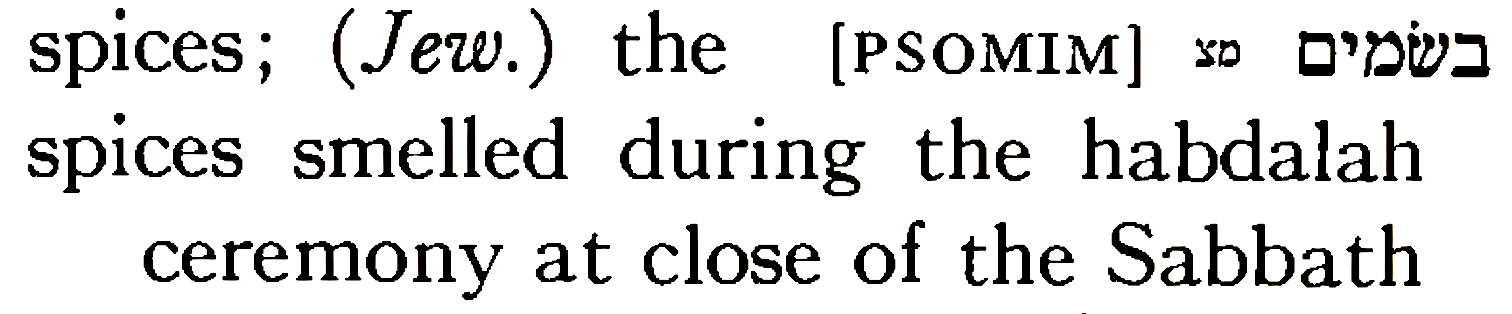
The voicing assimilation rule also affects sequences of consonants at the beginning of words. For historical reasons, such a mismatch in voicing is especially common in words of Hebrew and Aramaic origin. Consider, for example, the word בשׂמים bsomim ‘spices,’ produced in the following excerpt by Icek Mekler from Radom, Poland. Because the ב b is immediately followed by the voiceless שׂ s — with no vowel between them — the ב b becomes voiceless: psomim.
פֿאַרשידענע, פֿאַרשידענע בשׂמים farshidene, farshidene bsomim
Icek Mekler (Tape 1, 24:55–25:00)
From the collection of the USC Shoah Foundation
Indeed, if you look up this word in any standard dictionary that provides transcriptions for loshn-koydesh-origin words, such as Uriel Weinreich’s, you will see that the transcription actually comes “preprocessed” with this rule in mind: [PSOMIM].
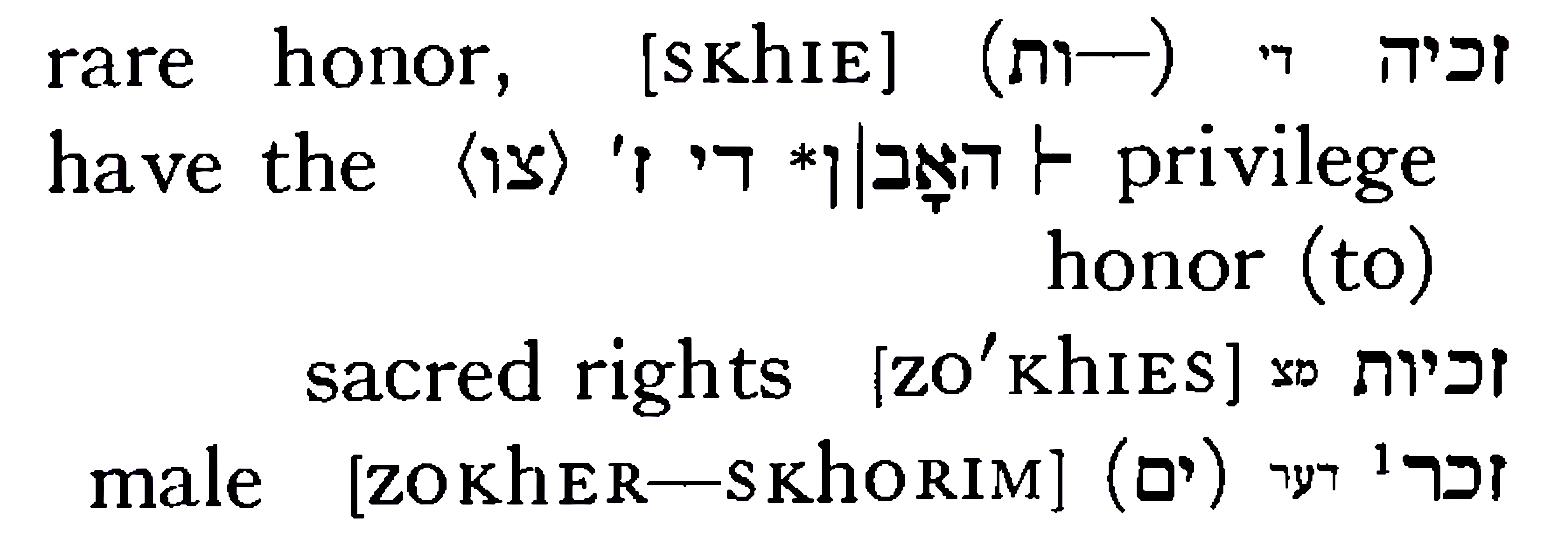
Another example is זכיה zkhie ‘privilege, good fortune,’ produced in the following excerpt by Zwi Miller, who grew up outside Warsaw. Because the voiced ז z is immediately followed by the voiceless כ kh, the ז z becomes voiceless: skhie.
און איך האָב געהאַט אַ גרױסע זכיה בײַ גאָט... un ikh hob gehat a groyse zkhie bay got...
Zwi Miller (Tape 5, 05:18–05:22)
From the collection of the USC Shoah Foundation
Dictionaries transcribe the word as [SKhIE], applying our rule. It is clear from other nearby dictionary entries, including the singular/plural nouns זכר/זכרים [ZOKHER — SKhORIM] ‘male(s),’ that the rule applies only in contexts where ז z is immediately followed by כ kh. When a vowel appears after the ז z — so, when the following sound is not a voiceless consonant — it remains voiced.
Finally, an important note for English-speaking Yiddish students: One area in which this rule directly conflicts with the phonology of English is in possessive nouns. Although the possessive suffix in English is written ’s, it is actually pronounced [z] by default. We can see this in forms like Hannah’s or Billy’s where the name ends in a vowel and the suffix is pronounced with voicing. The same voiced [z] appears when the name ends in a voiced obstruent consonant, such as Meg’s or Bob’s. In fact, it is only when the possessor ends in a voiceless consonant, like Mark’s or Robert’s, that the suffix is pronounced as a true [s], i.e., it assimilates backwards(!) to the voicing of the preceding consonant.6 In Yiddish, however, the ־ס -s possessive suffix is a true [s], i.e., voiceless: חנהס Khanes ‘Hannah’s’ is pronounced [χanəs], not [χanəz]. This means that when the final consonant of the possessor (a name or common noun) is voiced, our rule applies and it becomes voiceless. Thus, for a name like זעליג Zelig, the possessive form is not pronounced [zeligz] (as in English) but rather as [zeliks].
We can hear this in the pronunciation of װײַבס vaybs ‘wife’s’ from the testimony of Leibush Lichtenstein, a speaker of Polish Yiddish. The possessive noun appears twice in this excerpt, and in both instances,7 the ב b is pronounced as voiceless: vayps.
און װאָס האָט פּאַסירט מיט מײַן װײַבס פֿאָטער, מיט מײַן װײַבס עלטערן... un vos hot pasirt mit mayn vaybs foter, mit mayn vaybs eltern...
Leibush Lichtenstein (Tape 4, 11:02–11:08)
From the collection of the USC Shoah Foundation
From Voiceless to Voiced
All of the examples presented so far have shown that when a voiced obstruent consonant is immediately followed by a voiceless one, it becomes voiceless. However, the rule also applies in the alternative scenario: when a voiceless consonant is immediately followed by a voiced consonant, it becomes voiced.
(As we will see in the next section, however, the voiceless-to-voiced assimilation rule varies somewhat in its implementation across dialects.)
Here are excerpts in which two speakers of different dialects, Rachel Goldberg (Warsaw) and Meishe Geguzhinskis (Kaunas), pronounce the word עקזאַמען ekzamen. In both clips, the ordinarily voiceless ק k becomes voiced (pronounced like ג g) because it appears immediately before the voiced ז z: [egzamən].
און דערנאָך איז געװען אַן עקזאַמען. un dernokh iz geven an ekzamen.
Rachel Goldberg (Tape 1, 14:10–14:13)
From the collection of the USC Shoah Foundation
דאָרטן האָט מען מיר אָנ- אָנגענומען אָן אַן עקזאַמען. dortn hot men mir on- ongenumen on an ekzamen.
Meishe Geguzhinskis (Tape 1, 09:38–09:42)
From the collection of the USC Shoah Foundation
Here is a diagram showing how voicing spreads from ז z to ק k:
As mentioned above, mismatched sequences of voiceless and voiced consonants very often appear in words of Hebrew and Aramaic origin. For example, the word הקדש hekdesh ‘poorhouse, hospice’ contains a voiceless ק k immediately followed by a voiced ד d. As a result, the ק k is replaced by its voiced counterpart, ג g: hegdesh. And just as before, standard dictionaries transcribe this word with the rule in mind: [HEGDESh]. Here is the word pronounced by Ester Anafi, who grew up in Sosnowiec west of Kraków:
ס'איז געװעזן אַ הקדש. s'iz gevezn a hekdesh.
Ester Anafi (Tape 4, 08:48–08:51)
From the collection of the USC Shoah Foundation
Another example is the word חשבון kheshbn ‘account, reckoning.’ Because ש sh is voiceless and ב b is voiced, the ש sh is pronounced with its voiced counterpart: זש zh. As expected, the word is transcribed this way in standard dictionaries: [KhEZhBM]. (Why the final consonant is pronounced [M] is explained here.) Here again is an excerpt from Meishe Geguzhinskis:
און מען האָט מיר צוגעשטעלט אַ חשבון... un men hot mir tsugeshtelt a kheshbn...
Meishe Geguzhinskis (Tape 1, 25:25–25:32)
From the collection of the USC Shoah Foundation
Exceptions and Dialect Differences
As the excerpts above have shown, anticipatory voicing assimilation can be found in speakers of all dialects. However, as with many other linguistic phenomena, exceptions exist. For example, phonologist Neil Jacobs has noted that, for whatever reason, /v/ often does not participate in voicing resolution; words like סבֿיבֿה svive ‘environment’ and תּבֿואה tvue ‘grain’ are pronounced “faithfully” to their original/written forms and not according to the rules described here (i.e., not as “zvive” or “dvue”).8
There are also important differences across dialects. For example, while Central (“Polish”) Yiddish voices the ש sh in the middle of single words like חשבון khezhbm, it does not voice the ס s in phrases like דאָס בוך dos bukh, where the mismatched consonants appear in adjacent words. Northeastern (“Lithuanian”) Yiddish, however, does voice the ס s in this context.9 Listen to how Aizik Dimantstein (from present-day Latvia) voices the ס s in the phrase דאָס בין איך dos bin ikh, so that it is pronounced with [z].
דאָס בין איך, אײַזיק דימאַנטשטײן. dos bin ikh, Ayzik Dimantshteyn.
Aizik Dimantstein (Tape 4, 06:13–06:16)
From the collection of the USC Shoah Foundation
(For the very same reason, he also voices the final ק k in his first name, because his surname starts with voiced ד d: “Ayzig Dimantshteyn.”)
Here is another speaker of Northeastern Yiddish, Rita Yelgin from Slonim (today in Belarus), producing the compound noun ייִחוס־בוך yikhes-bukh ‘book of family ancestry’ with [z] as expected:
דאָס איז אַ ייִחוס־בוך. dos iz a yikhes-bukh.
Rita Yelgin (Tape 1, 06:17–06:19)
From the collection of the USC Shoah Foundation
Also characteristic of some parts of Northeastern Yiddish is the voicing of כ kh when it appears before another voiced sound. Although the Yiddish alphabet does not have a letter corresponding to this sound, it is nonetheless very common in speech. (As indicated in the first table above, there is a symbol for this sound in the IPA: [ɣ]). For example, listen to Gita Radouski (from Kovne/Kaunas) and Lee Shuldman (from Vilne/Vilnius) pronounce the כ kh in the separable prefix נאָכ־ nokh- when it appears before the voiced ג g in the past participles נאָכגעלאָפֿן nokhgelofn ‘ran after’ and נאָכגעזונגען nokhgezungen ‘sang after.’ In both words, the כ kh is voiced.
בין איך נאָכגעלאָפֿן... bin ikh nokhgelofn...
Gita Radouski (Tape 4, 29:01–29:05)
From the collection of the USC Shoah Foundation
נאַכער האָט מען נאָכגעזונגען... nakher hot men nokhgezungen...
Lee Shuldman (Tape 2, 23:19–23:22)
From the collection of the USC Shoah Foundation
The voicing of כ kh may be tricky to perceive depending on your first language. But if you hear a sound similar to a Yiddish ר r, this is the reason.
The voicing of כ kh in Northeastern Yiddish even applies across word boundaries — that is, when כ kh appears at the end of one word and the next word starts with a voiced consonant. Here is an example from Sheytah Zilber, pronouncing the phrase שטיבלעך דאָרטן shtiblekh dortn ‘small houses over there,’ with ך kh adopting the voicing of the ד d that begins the next word.
װאָס זײ האָבן געלעבט אין די שטיבלעך דאָרטן... vos zey hobn gelebt in di shtiblekh dortn...
Sheytah Zilber (Tape 1, 24:23–24:26)
From the collection of the USC Shoah Foundation
(And to review: we also hear the word געלעבט gelebt ‘lived’ pronounced like gelept, because ב b assimilates to the voiceless ט t that comes after it.)
Across word boundaries, it is relatively common to find sequences of more than two consonants that disagree in their voicing. In these cases, the voicing value of the final consonant spreads to the preceding consonants, however many there are. Compare, for example, the word געמוזט gemuzt ‘must (past participle)’ in two different contexts. When the word appears in isolation, or before a vowel, the voiceless ט t causes the preceding ז z to become voiceless: [gəmust]. Here is Shmuel Bushkin again, pronouncing the word before the filler “uh”:
נו, מיר האָבן געמוזט, uh... nu, mir hobn gemuzt, uh...
Shmuel Bushkin (Tape 1, 15:19–15:22)
From the collection of the USC Shoah Foundation
However, when the word געמוזט gemuzt precedes a voiced obstruent, the voicing of that consonant spreads backwards to any preceding voiceless consonants, and so the participle is instead pronounced [gəmuzd]. Here is an excerpt where this can be heard:
איך האָב געמוזט בלײַבן. ikh hob gemuzt blaybn.
Shmuel Bushkin (Tape 6, 22:02–22:05)
From the collection of the USC Shoah Foundation
Another example comes from Faniah Zelbst (from Disne/Dzisna, today in Belarus), pronouncing the phrase שװענקט די װעש shvenkt di vesh ‘rinses the laundry.’ Because שװענקט shvenkt ends in two voiceless consonants and די di begins with a voiced consonant, the voicing spreads backwards to both of the preceding two consonants. As a result, we can hear her say “shven[gd]i vesh.” (We do not hear [d] twice, because consonants are not doubled in Yiddish.)
און שװענקט די װעש. un shvenkt di vesh.
Faniah Zelbst (Tape 4, 15:45–15:48)
From the collection of the USC Shoah Foundation
An analogous example can be heard from Mariia Voronova from Kelem (Kelmė, Lithuania): שיקט דער גלח shikt der galekh ‘the priest sends’ comes to be pronounced like “shi[gd]er galekh”:
שיקט דער גלח... shikt der galekh...
Mariia Voronova (Tape 2, 17:30–17:32)
From the collection of the USC Shoah Foundation
Conclusion
Voicing assimilation in sequences of obstruent consonants is a very important part of standard Yiddish pronunciation. As explained in most Yiddish textbooks, and as illustrated here, Yiddish generally resolves voicing mismatches through anticipatory assimilation, in which the voicing of an earlier consonant is modified to match the voicing of a later consonant. This involves voiced consonants becoming voiceless and voiceless consonants becoming voiced — although the latter rule is applied more robustly in Northeastern Yiddish, including across word boundaries. To the extent that standard Yiddish pronunciation adheres to the rule in all contexts,10 it seems to have been modeled after the pattern in Northeastern Yiddish. But again, all dialects exhibit these rules to a large degree, and they are therefore an important part of the grammatical knowledge that Yiddish students should strive to learn.
Exercises
(1) Fill in the following present-tense conjugation table for the verbs מוזן muzn ‘must’, שרײַבן shraybn ‘write,’ and האַלדזן haldzn ‘embrace,’ using the Yiddish alphabet. Then, either in a modified Yiddish spelling or in modified Yiddish transliteration (or, if you have experience with the IPA, using phonetic symbols), provide the actual pronounced form of each word according to the rules described in this article.
| Person | Singular | Plural |
|---|---|---|
| 1st | (איך) |
(מיר) |
| 2nd | (דו) |
(איר) |
| 3rd | (ער/זי/עס) |
(זײ) |
(2) For each of the following words and phrases,11 determine which consonants need to have their voicing value changed, and why. Then try to pronounce each word/phrase slowly, using the appropriately voiced or voiceless consonants.
For the words with missing transliterations, look these up in standard dictionaries.
| Yiddish | Transliteration | Translation | |
|---|---|---|---|
| 1 | קריגסטו | krigstu | ‘you receive’ |
| 2 | געלױבט | geloybt | ‘praised’ |
| 3 | זאָג שױן | zog shoyn | ‘say already’ |
| 4 | אױסזען | oyszen | ‘appear, look’ |
| 5 | אײַזקאַסטן | ayzkastn | ‘refrigerator’ |
| 6 | אױפֿװעקן | oyfvekn | ‘wake up’ |
| 7 | ראַנדקע | randke | ‘(romantic) date’ |
| 8 | זיסװאַרג | zisvarg | ‘candy, sweets’ |
| 9 | שװיצבאָד | shvitsbod | ‘steam bath’ |
| 10 | רעדקאָלעגיע | redkolegye | ‘editorial board’ |
| 11 | קאָפּװײטיק | kopveytik | ‘headache’ |
| 12 | אָפּבאָדן | opbodn | ‘bathe’ |
| 13 | סוף־װאָך | sof-vokh | ‘weekend’ |
| 14 | דװקא | ‘precisely’ | |
| 15 | שדכן | ‘matchmaker’ | |
| 16 | משגיח | ‘inspector (at kosher establishment)’ | |
| 17 | בשׂורה | ‘announcement’ | |
| 18 | קבצן | ‘poor man’ |
Notes and References
-
Isaac L. Bleaman, “Uriel Weinreich: Contact Linguist, Historical Linguist, and Yiddishist Par Excellence,” Journal of Jewish Languages 5, no. 2 (2017): 131–143, https://doi.org/10.1163/22134638-05021135. ↩
-
See, for example, Lea Schäfer, Syntax and Morphology of Yiddish Dialects: Findings from the Language and Culture Archive of Ashkenazic Jewry (Hildesheim: Georg Olms, 2023). Recordings from the interviews that Weinreich and his team conducted can be displayed on the main CSYE Map through an optional layer. ↩
-
Uriel Weinreich, College Yiddish: An Introduction to the Yiddish Language and to Jewish Life and Culture (New York: Yiddish Scientific Institute–YIVO, 1949), 10. ↩
-
See: Zalmen Reyzen, Gramatik fun der yidisher shprakh: Ershter teyl [Grammar of the Yiddish Language: Part One], 2nd ed. (Vilnius: Shreberk, 1920), 48; Ayzik Zaretski, Yidishe gramatik: Nay-ibergearbete oysgabe [Yiddish Grammar: Newly-Revised Edition] (Vilnius: Kletskin, 1929), 293–294; Weinreich, College Yiddish, 20; Yudl Mark, Gramatik fun der yidisher klal-shprakh [A Grammar of Standard Yiddish] (New York: Congress for Jewish Culture, 1978), 21–22; Dovid Katz, Grammar of the Yiddish Language (London: Duckworth, 1987), 29–31; Mordkhe Schaechter, Yidish tsvey: A lernbukh far mitndike un vaythalters [Yiddish II: An Intermediate and Advanced Textbook], rev. ed. (New York: League for Yiddish, 1995), 423–424; Neil G. Jacobs, Yiddish: A Linguistic Introduction (Cambridge: Cambridge University Press, 2005), 120–121; Solomon A. Birnbaum, Yiddish: A Survey and a Grammar, 2nd ed. (Toronto: University of Toronto Press, 1979/2016), 211; Asya Vaisman Schulman, Jordan Brown, and Mikhl Yashinsky, In eynem: The New Yiddish Textbook (Amherst: Yiddish Book Center, 2020), 14, 16; Isaac L. Bleaman, Jacob J. Webber, and Samuel K. Lo, “Speech Synthesis in the ‘Mother Tongue’: Designing, Training, and Evaluating a Text-to-Speech System for Yiddish,” Journal of Jewish Languages 11, no. 1 (2023): 31–32, https://doi.org/10.1163/22134638-bja10034. ↩
-
Weinreich, College Yiddish, 20. ↩
-
The same holds for the English plural suffix -s, which is ordinarily pronounced [z] unless it is preceded by a voiceless consonant. In Yiddish, the plural ־ס -s is always voiceless. ↩
-
In the first instance, the voiceless initial consonant of the following word פֿאָטער foter ‘father’ also plays a role in causing the preceding consonants to become voiceless: “vayps foter.” ↩
-
Jacobs, Yiddish, 121. ↩
-
Jacobs, Yiddish, 120, 128–129. ↩
-
This is stated, for example, in Katz, Grammar, 29–31. ↩
-
Some of these examples come from Katz, Grammar, 29–31. ↩
Cite this article
- Bleaman, Isaac L. 2026. "Pronunciation Guide: Voicing Assimilation." In Isaac L. Bleaman (ed.), Corpus of Spoken Yiddish in Europe (CSYE) Glosses, https://www.yiddishcorpus.org/csye/glosses/pronunciation-guide-voicing-assimilation. Accessed .
-
@InCollection{Bleaman-2026,
    author    = {Isaac L. Bleaman},
    booktitle = {Corpus of {Spoken} {Yiddish} in {Europe} ({CSYE}) {Glosses}},
    editor    = {Isaac L. Bleaman},
    title     = {Pronunciation Guide: Voicing Assimilation},
    url       = {https://www.yiddishcorpus.org/csye/glosses/pronunciation-guide-voicing-assimilation},
    urldate   = {},
    year      = {2026}
}
© Isaac L. Bleaman, 2026. This work is licensed under CC BY-NC-SA 4.0.